Friday, November 30, 2012

Going on a Diet Mr. Mycroft?

"Mycroft Holmes was a much larger and stouter man than Sherlock. His body was absolutely corpulent, but his face, though massive, had preserved something of the sharpness of expression which was so remarkable in that of his brother. His eyes, which were of a peculiarly light, watery gray, seemed to always retain that far-away, introspective look which I had only observed in Sherlock’s when he was exerting his full powers." - The Greek Interpretar

It would be putting it mildly that Sherlock Holmes' brother, Mycroft is big. Mycroft Holmes was portrayed as being quite immense and fairly lazy, lounging around the Diogenes Club (when he was not working for Her Majesty's Government). But, what is quite unusual is that in many adaptations of the Sherlock Holmes stories, Mycroft Holmes is not depicted as being the large gentleman he is described as.

The first time that a lean Mycroft was seen in films was Christopher Lee's characterization in Billy Wilder's, "The Private Life of Sherlock Holmes." Lee's Mycroft is a crafty and devious spy who cannot help but interfere in his younger brother's affairs. Lee's Mycroft Holmes is one of the most enjoyable depictions of the character - his pompous charisma simply oozing in his scenes with Robert Stephens' detective. It is very possible then that Christopher Lee's portrayal of the great detective's elder brother influenced Mark Gatiss' equally fantastic portrayal in BBC's "Sherlock."
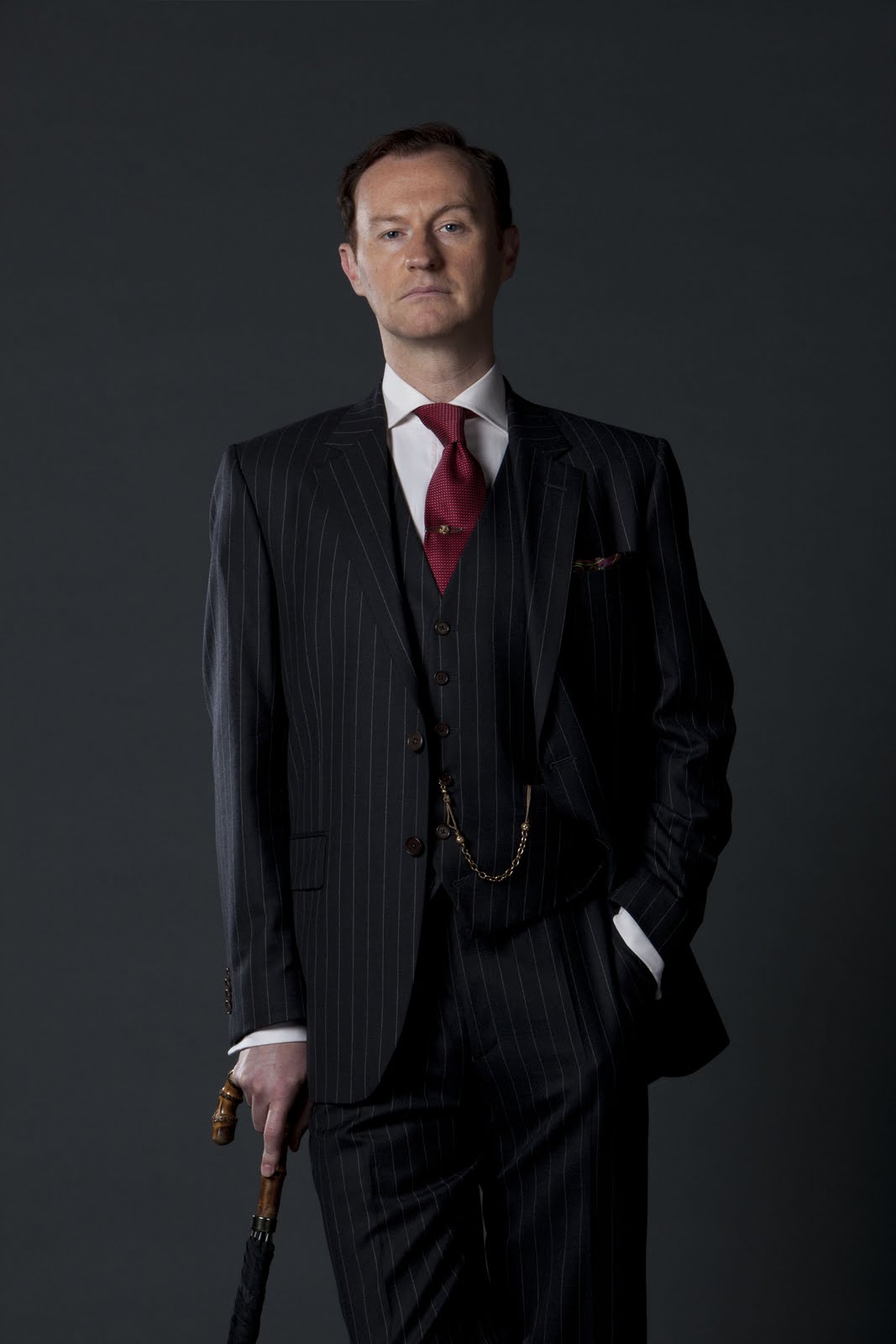
Mark Gatiss as Mycroft Holmes
One cannot help but like Mark Gatiss as Mycroft Holmes. First glimpsed in "A Study in Pink," Mycroft introduces himself to John Watson as Sherlock's "arch-enemy." It is not revealed until the end of the episode that this mysterious umbrella-toting figure is not James Moriarty, but Mycroft. In "The Great Game," Mycroft returns and it is revealed that Mycroft is in fact going on a diet, explaining his thin appearance.

Gatiss is a pleasure to watch. He plays the part of Mycroft as though his childhood feuds with his brother are in full-swing and any altercations between Mycroft and Sherlock are very funny indeed. "I'll be mother." Mycroft says as he pours tea in Buckingham Palace in "A Scandal in Belgravia." Sherlock sourly replies: "And there's our childhood in a nutshell."

This begs the question - if the actor is good enough, does Mycroft Holmes really have to be described exactly as he is in the canon? I am as much a stickler for canonical accuracy as any other Sherlockian, however with such gifted actors as Christopher Lee and Mark Gatiss taking on the part, Mycroft Holmes is just as remembered as he ever was - even if he is on a diet.

Tuesday, November 27, 2012

A Study in Ink - The Illustrators of Sherlock Holmes

A point which makes the original Sherlock Holmes stories quite unique are the original illustrations which accompanied the stories. Whether they were published in The Strand Magazine or Collier's Weekly, illustrators lent their talents to giving the public its first real look at Sherlock Holmes and Dr. Watson. Today, I want to peruse some of these illustrators who were quite influential in shaping Sherlock Holmes.

One of the earliest efforts of illustrating the Sherlock Holmes stories went badly. Arthur Conan Doyle's alcoholic father who was at this point confined to an insane asylum created a number of illustrations for Doyle's "A Study in Scarlet." These illustrations from Doyle are quite shocking to the modern viewer for all of the characters appear quite decrepit and ill. Worst of all, these illustrations feature a Sherlock Holmes with a strange bushy beard!

Sherlock Holmes delivers a knock-out blow
in this illustration from "The Solitary Cyclist" by Sidney Paget
By far the most famous artist who illustrated the original Sherlock Holmes stories was Sidney Paget. Paget (1860-1908) illustrated three sets of short stories and one novel for the Strand Magazine. Interestingly, the art editor of the magazine actually wanted Sidney's brother, Walter Paget (also an artist) to do the illustrations for the stories, but the commission went to Sidney in error. However, in the end, Walter Paget did end up connected with Sherlock Holmes in more way than one. Sidney Paget used his younger brother as the model for Holmes. Later, in 1913, Walter Paget did end up illustrating "The Adventure of the Dying Detective."

Sidney Paget is today credited for giving the detective two of his most famous attributes - the deerstalker hat and Inverness cape. In Arthur Conan Doyle's original writing, the hat which Sherlock Holmes wears in the country is never explicitly called a deerstalker - being referred to merely as "an ear-flapped travelling cap." Paget, who was a fan of the deerstalker and wore the hat often, decided to depict the detective wearing such a hat. The rest is history...

"The Priory School" by Fredric Dorr Steele
While Sidney Paget is the most famous artist from Britain to have illustrated the stories, an equally famous artist in the United States was creating fantastic illustrations for the magazine, Collier's Weekly. Fredric Dorr Steele (1874-1944) created a number of fantastic character studies for the magazine. Steele's illustrations are quite obviously based on the countenance of the American actor, William Gillette who brought the role of Holmes to the stage in his original four-act play which debuted in 1899.

Aside from the two most famous artists to illustrate the Sherlock Holmes stories, there have been many other illustrators who have taken up their art supplies to transfer the great detective's likeness onto paper. Richard Gutschmidt and Josef Fredrich were both European artists whose illustrations were featured in German and Czech translations.

Some of the most recent illustrations of the Sherlock Holmes stories are quite well-done. Artist Nis Jessen illustrated a striking and beautifully done version of "A Study in Scarlet." In addition, artist I.N.J Culbard and Ian Edington have collaborated to transform all four of Doyle's Sherlock Holmes novels into wonderfully crafted graphic novels. We can only hope that we can see more from these illustrators in the future.


Monday, November 26, 2012

Review - "Sherlock Holmes vs. Dracula"

There have been many different variations on the concept of the world's most famed detective squaring off against the king of vampires - Count Dracula. There is David Stuart Davies' fantastic sequel to "The Hound of the Baskervilles," entitled "The Tangled Skein." There are two novels with the same idea by Fred Saberhagen, "The Holmes, Dracula File" and "Seance for a Vampire." Stephen Seitz's "Sherlock Holmes and the Plague of Dracula" and now Loren D. Estleman's "Sherlock Holmes vs. Dracula."

Actually, Estleman's rather melodramatically titled novel was the first book which featured the pairing of the world's greatest detective against the vampire. Titan Books had already re-released Estleman's second Sherlock Holmes effort, "Dr. Jekyll and Mr. Holmes," which paired Holmes with Dr. Jekyll and Mr. Hyde. Estleman's work was quite fantastic, so I expected a lot from this book - being re-released from Titan Books as well.

"Sherlock Holmes vs. Dracula," (also known as "The Adventure of the Sanguinary Count") nimbly fits Sherlock Holmes and Dr. Watson into the plot of Bram Stoker's famous novel. When a ship runs aground on the cost of Whitby, Sherlock Holmes is called in to investigate. No one was aboard the ship except for the captain - quite dead, tied to the wheel and grasping a crucifix in his hands. Witnesses reported seeing a great dog leap off the ship and rush into the night. Shortly thereafter, a number of mysterious attacks on London's Hampstead Heath attract the detective's attention, and soon he makes the acquaintance of Professor Abraham Van Helsing, who informs Holmes that these recent events are the work of the vampire, Count Dracula. What ensues is a deadly game of cat-and-mouse with the king of vampires and the world's greatest detective.

As I mentioned earlier, I found "Dr. Jekyll and Mr. Holmes" to be a thoroughly enjoyable pastiche and so I expected quite a bit from Mr. Estleman. What I liked so much about his novel was that he inserted the characters of Holmes and Watson into  Robert Louis Stevenson's novella, and it still managed to feel like a genuine Sherlock Holmes story. "Sherlock Holmes vs. Dracula" did follow the same routine, but perhaps not to the same caliber. While the plot of this novel did follow Bram Stoker's original, I was rather disappointed that Holmes and Watson were not rubbing elbows with the characters from the original novel as much.

Furthermore, the beginning of the book was done very nicely - creating an atmosphere of genuine mystery with the wrecked ship. After Holmes learned of his adversary, there was very little of that same mystery left and the brilliant deductions much beloved by fans of Sherlock Holmes took a back-seat to action and adventure as Holmes and Watson pursued the vampire across land and sea.

Onto the good things about "Sherlock Holmes vs. Dracula: The Adventure of the Sanguinary Count" though. Speaking of sea, one of the most exciting scenes in the novel was a prolonged chase on steam launch after a ship commandeered by Count Dracula. A number of these chases were thoroughly exciting and did leave the reader anxious to find out what happens next.

The characterizations of Holmes and Watson were brilliantly done. Sherlock Holmes and Watson felt very much like their canonical counterparts. My only nitpick would be that Holmes seemed a bit too excepting of the supernatural in this story. It felt unusual that Holmes did not pursue a logical explanation after Van Helsing told him about their vampiric foe. But nevertheless, this is a small gripe to make against a book which has a number of excellent redeeming qualities.

To sum up, while Loren D. Estleman's first foray into Sherlock Holmes territory may not be as good as his second, "Sherlock Holmes vs. Dracula" was a very enjoyable novel. Combining a great deal of action and suspense, the book told a very entertaining story. "Sherlock Holmes vs. Dracula" deserves a well-rewarded 4 out of 5 stars.


Friday, November 23, 2012

Review - "The Talons of Weng-Chiang"

Today's review isn't exactly a Sherlock Holmes item, but it is rather close. Today I am reviewing the thrilling six-part episode of "Doctor Who," "The Talons of Weng-Chiang" which is clearly modeled after the great detective.

However, before I go too far, allow me to give just a bit of background information on the show for those of you who may be unfamiliar with it. "Doctor Who" is a science-fiction adventure show which debuted in 1963. The Doctor is a renegade member of an alien race known as The TimeLords. He has stolen a TARDIS (Time And Relative Dimension In Space), a time machine and space-ship which is disguised as a 1960's police-box, and goes around the universe (and through time) saving the world.

This particular serial features the Fourth incarnation of the Doctor. Each time a TimeLord faces death, they can change every cell in their body - leading to a new version of the Doctor. Tom Baker stars as the Fourth Doctor in this serial - which in 2003 was voted as the best "Doctor Who" story.

"The Talons of Weng-Chiang" find the Doctor and his travelling companion, Leela in Victorian London. What started out as a pleasant trip turns deadly when a man dies right before the Doctor's eyes, which leads the Doctor and Leela into a dangerous world of Chinese Tongs, disappearing women and a giant rat in the sewers of London.

Tom Baker as The Doctor in "The Talons of Weng-Chiang"
"The Talons of Weng-Chiang" was my first foray into the "Doctor Who" universe and I was attracted to it by the supposed Sherlock Holmes connections. The Doctor dresses in a deerstalker hat and Inverness cape throughout this episode, and meets a medical man by the name of Professor Litefoot who acts as his Watson throughout the story. What's more, the Doctor takes to the sewers of London to find the Giant Rat which lives there. Of course, this is a direct reference to the famed untold story from the canon, and it is an absolute delight for a Sherlock Holmes enthusiast like me.

Tom Baker is quite marvelous as the Doctor. He is the longest-running Doctor in the series going from 1974 to 1981. He is a favourite of many fans of both the new series and the old. It looks as though Baker is having a great deal of fun in the role of the Doctor for this adventure, and his high-spirited nature spills over into the episode itself. Christopher Benjamin appears as Henry Gordon Jago, the owner of a small music hall who works alongside the Doctor and Litefoot and John Bennett is wonderful as the creepy music hall musician.

Tom Baker as Sherlock Holmes in a 1982
television serial of "The Hound of the Baskervilles"
In all, "The Talons of Weng-Chiang" may not be a Sherlock Holmes story, but it is certainly akin to the stories of Sir Arthur Conan Doyle. To many, the Doctor is Holmes' intergalactic counterpoint. Interestingly, after Tom Baker's term as the Doctor came to an end, Baker went on to appear as the detective in a 1982 television serialization of "The Hound of the Baskervilles." While, Baker seems to be enjoying himself immensely as the Doctor, Baker's performance as Holmes is quite the opposite. While Baker's performance isn't bad, he suffers from a dull Watson and an overall dull adaptation.

"Doctor Who" continued on until 1989 at which point the show went off the air. It returned in 1996 with a made-for-television movie and didn't return to the BBC until 2005 under the helm of Russell T. Davies. In 2010, Steven Moffatt took over as the show-runner. Moffatt is also the co-creator of BBC's "Sherlock."

"The Talons of Weng-Chiang" is a very enjoyable television serial for fans of both "Doctor Who" and Sherlock Holmes. Seeing the great detective's alien equal is a great deal of fun, and the six-part serial is perhaps the epitome of entertainment. "The Talons of Weng-Chaing" deserves a worthy 4 out 5 stars.


Thursday, November 22, 2012

The Twelve Best Stories?

Sir Arthur Conan Doyle published an article in 1927 in which he named what he thought were his favourite - the twelve best Sherlock Holmes short stories. His list is quite and interesting one and includes:

  • The Speckled Band
  • The Red-Headed League
  • The Dancing Men
  • The Final Problem
  • A Scandal in Bohemia
  • The Empty House
  • The Five Orange Pips
  • The Second Stain
  • The Devil's Foot
  • The Priory School
  • The Musgrave Ritual 
  • The Reigate Squires
This leads me to wonder whether these are in fact the Twelve Best stories. Of course a great deal of this list is subjective - and everyone has their own favourite stories. Interestingly, three of my favourite five stories also appear on Conan Doyle's list, but some of his choices are different. Such famous and beloved stories as "Silver Blaze" and "The Naval Treaty" do not appear on Conan Doyle's list, while "The Empty House" does.

From "The Five Orange Pips"
Granted, Doyle did put quite a bit of thought into his choices. However, he does not substantiate some of these choices (especially his more obscure choices). For example, "The Five Orange Pips" appears on his list. This story is a fairly odd choice considering there is very little detective work actually done of by Holmes in this story. Doyle said he choose the story because it was one of the more "dramatic stories."

Furthermore, Sir Arthur Conan Doyle decided not to select any stories from the last collection of short-stories, "The Case-Book of Sherlock Holmes." This is interesting considering that some of the best of the later stories can be found in this last anthology. "The Illustrious Client," "The Three Garridebs" and "The Problem of Thor Bridge" all coke from "The Case-Book."

I come now to the hardest part of this post - I will deliver to you my list of the twelve best Sherlock Holmes short-stories. So here goes...


  • "The Speckled Band" - Doyle's story is by far one of the best from the canon. While not being a straight-forward whodunit, "The Speckled Band" is an early example of the how-done-it school of mystery, and is an early example of the locked room mysteries made famous by John Dickson Carr during the Golden Age of Mystery Fiction.
  • "The Red-Headed League" - Despite the somewhat outlandish nature of this story, "The Red-headed League" is one of the best examples of a mystery in the canon.
  • "The Six Napoleons" - Like "The Red-Headed League" and "The Speckled Band," "The Six Napoleons" offers one of the best mysteries in the canon. Although not all of the clues are presented to the reader, the twist ending of what was really in those plaster busts is quite ingenious.
  • "The Dancing Men" - One of the earliest examples of mystery fiction came from Edgar Allan Poe's story, "The Gold Bug" which is centered primarily on code-breaking. Not only does "The Dancing Men" pay homage to this story, but also throws in a murder.
  • "The Problem of Thor Bridge" - Again, this story displays some of the best mystery elements in all of the canon, and features an interesting twist ending befitting of Agatha Christie. 
  • "The Illustrious Client" - Although there is no detective work for Sherlock Holmes in this story, "The Illustrious Client" features one of the best villains from the canon and plays out as a very dramatic story.
  • "Silver Blaze" - Surely one of the most beloved stories in the canon, "Silver Blaze" has yet another magnificent mystery plot and features the infamous line about "the dog in the nighttime."
  • "The Three Garridebs" - Although the plot is in essence recycled from "The Red-Headed League," "The Three Garridebs" is one of the best stories which truly shows how deeply Sherlock Holmes cares about his only friend, Dr. Watson.
  • "The Devil's Foot" - Surely one of the darkest stories in the canon, "The Devil's Foot" is an un-discovered gem.
  • "The Solitary Cyclist" - This interesting story combines high-spirited adventure with mystery and suspense. 
  • "The Bruce-Partington Plans" - Featuring the second appearance of Mycroft Holmes, this story features one of Doyle's most clever solutions. 
  • "The Sussex Vampire" - While not involving the same dramatic elements present in the other stories, "The Sussex Vampire" is a well-crafted little mystery and of course features the lines referring to the Giant rat of Sumatra.

Well, there you have it - my top twelve list. Please feel free to comment and tell me what your favourite short-stories are. What do you think of my list, or Doyle's?


Wednesday, November 21, 2012

Sherlock Holmes - The Original Hard-Boiled Detective?

The hard-boiled detective seemed to emerge during the late 1930's and 1940's with stories like "The Maltese Falcon" and "The Big Sleep" by Dashiell Hammett and Raymond Chandler respectively. However these hard-boiled private eyes may have been inspired by Sherlock Holmes, who could have served as a template for the tougher breed of detectives who emerged during the days of the Second World War.

Inspector Lestrade and Holmes
arresting the killer in "A Study in Scarlet"
The evidence showing that Sherlock Holmes acted like one of the hard-boiled detectives is quite great. Starting right away in "A Study in Scarlet," Sherlock Holmes shows that he is rather rough-around-the-edges. After the murderer Jefferson Hope has been captured, it is Holmes and Inspector Lestrade who throw the criminal at one of the windows of the flat. Holmes is known to engage in fisticuffs in "The Sign of Four." Holmes exchanges some choice words with McMurdo, the guard at the home of Bartholomew Shalto.
“I don’t think you can have forgotten me. Don’t you remember that amateur who fought three rounds with you at Alison’s rooms on the night of your benefit four years back?”“Not Mr. Sherlock Holmes!” roared the prize-fighter. “God’s truth! how could I have mistook you? If instead o’ standin’ there so quiet you had just stepped up and given me that cross-hit of yours under the jaw, I’d ha’ known you without a question."
Sherlock Holmes forays into physical violence are spread throughout the canon. It is with his knowledge of Baritsu that Holmes is able to dispatch Professor Moriarty in "The Final Problem" and in "The Empty House," Doctor Watson steps forward to pistol-whip Colonel Moran who is choking the detective.

In "The Six Napoleons," Sherlock Holmes tackles the criminal to the ground.
"With the bound of a tiger Holmes was on his back, and an instant later Lestrade and I had him by either wrist, and the handcuffs had been fastened."
However, it is the later stories where the Sherlock Holmes stories really show indications of paving the way for the hard-boiled detective stories. In "Sherlock Holmes for Dummies," the authors describe how "The Valley of Fear," the last of the four novels acts as a template for the hard-boiled detective novels. The second part of the novel details the activities of a group of gangsters who operate out of the Vermissa Valley in Pennsylvania. Then the short story, "The Three Garridebs," the opening lines of the story could have come from the opening passage of a Raymond Chandler crime thriller.
"It may have been a comedy, or it may have been a tragedy. It cost one man his reason, it cost me a blood-letting, and it cost yet another man the penalties of the law. Yet there was certainly an element of comedy. Well, you shall judge for yourselves."
Dr. Watson is shot in "The Three Garridebs"
And later in the same story, Dr. Watson gets into a rather precarious situation after being shot by the culprit.
"In an instant he had whisked out a revolver from his breast and had fired two shots. I felt a sudden hot sear as if a red-hot iron had been pressed to my thigh. There was a crash as Holmes’s pistol came down on the man’s head. I had a vision of him sprawling upon the floor with blood running down his face while Holmes rummaged him for weapons. Then my friend’s wiry arms were round me, and he was leading me to a chair.
In all, it evident that the Sherlock Holmes stories oftentimes featured a darker, harsher reality than was expected in the Victorian and Edwardian Eras, and certainly opened the door to writers in the future.
 

Tuesday, November 20, 2012

Review - "The Tangled Skein"

Big Finish's next audio drama takes the characters out of the realm of mystery and headlong into a world of suspense and horror as Sherlock Holmes comes face-to-face with the king of vampires, Count Dracula.

Picking up where "The Hound of the Baskervilles" left off, Sherlock Holmes learns that the villainous Jack Stapleton is in fact still alive and out for revenge against the detective. When a number of mysterious attacks occur, the victims drained of blood and with two small pin-pricks on their throats, Holmes ends up associating himself with Professor Van Helsing. Van Helsing tells Holmes that the source of these attacks is Count Dracula, and soon Holmes and Watson are speeding off towards Dartmoor once again in search of the king of the un-dead.

"The Tangled Skein" was originally published by David Stuart Davies in 1995. Richard Dinnick, adapter of Big Finish's "The Hound of the Baskervilles" was on hand once more to adapt this pastiche and makes this drama very exciting to listen to. I gave nothing but praise to Dinnick's adaptation of "Hound" but he surpasses himself with this adventure. All of the elements work splendidly together making for a genuinely scary and very exciting audio drama.

The striking cover from
"The Tangled Skein"
"The Tangled Skein" may not be everyone's cup of tea though. While the concept of Sherlock Holmes facing Dracula is not new, it does make one have to be open to the supernatural occurrences which take place in this book. For the most part, the first installment is more mystery driven as Holmes and Watson piece together the clues which lead them to Professor Van Helsing, but the second part is much more akin to a thriller as the great detective pursues the vampires across Dartmoor. Seeing Sherlock Holmes break his ethical code ("The world is big enough...no ghosts need apply") may be a bit jarring for some.

Interestingly, "The Tangled Skein" does not follow the plot of Bram Stoker's novel. David Stuart Davies says that he was inspired by the Hammer Horror films made from the late '50's until the mid '70's with Christopher Lee playing the role of Dracula and Peter Cushing as Van Helsing. His novel certainly mirrors the blood-and-thunder, Gothic style of the Hammer Horror films expertly.

As usual, Nicholas Briggs and Richard Earl are excellent. Guest star Barnaby Edwards is fantastic as well returning as Jack Stapleton. The sound effects and music are wonderful as usual and really add to the horror-like atmosphere of the story. However, you should be warned - "The Tangled Skein" is an extremely violent story (especially in its final half). The sound effects certainly add to this gruesomeness, and there are times when shivers are liable to crawl up your spine. But...that means their doing it right - doesn't it?

All in all, "The Tangled Skein" is the jewel in the crown of the Big Finish Sherlock Holmes productions. I never (I repeat NEVER) do this, but "The Tangled Skein" deserves a 5 out of 5 stars.