Friday, December 26, 2014

Review - "Doctor Who - Last Christmas"


Warning - This review will contain spoilers

I was of the opinion that the inclusion of Santa Claus at the end of the Series 8 finale, Death in Heaven, shattered the morose and downbeat atmosphere which the episode invoked. Therefore, I went into this year's Christmas special with some mixed feelings. Would Father Christmas interrupt yet another episode's atmospherics? Let's take a closer look at Last Christmas.

After meeting Santa Claus (Nick Frost) on her rooftop, Clara (Jenna Coleman) is spirited away by the Doctor (Peter Capaldi) to the North Pole. A group of researchers stationed at the base have fallen victim to an alien race known as the Dream Crabs. When under the Crab's power, the victim enters a dream-like state and cannot separate reality from dreams. Soon, the Doctor comes to understand that their situation is more dire than he could anticipate and that Father Christmas may be their only hope for survival.

It is collective opinion of many Doctor Who fans that showrunner Steven Moffat is at his best when he's writing stand-alone episodes,ones which do not have to relate back to the overall arc of the series. I am in inclined to agree and I select Last Christmas as evidence of this. This Christmas episode managed to be quite intense and suspenseful, something which surprised me as most Christmas specials are lightweight in tone. Last Christmas is arguably the darkest Christmas special thus far - the characters' uncertainty about whether they are dreaming or not added real gravitas to the story. What's more, I'm sure I wasn't the only one who got a chill up their spine during Clara's dream sequence; a chalk board looming in the background foretelling her death if she didn't wake up.

"Nobody likes the tangerines"
Performances were, as expected, excellent. Peter Capaldi's Doctor has undergone a slight change in personality.Perhaps it was just the festive holiday spirit, but the Doctor seemed far less angry and uncaring. There was the occasional moment of true aloofness, but I wouldn't be surprised if the Twelfth Doctor's heart of ice continues to melt throughout Series 9. Jenna Coleman gave a genuine performance as she confronted her feelings about Danny Pink's death from Death in Heaven. I'm also happy with Clara returning for Series 9. She's been a good companion thus far - I only hope that she doesn't take centre stage too often like she did in Series 8, when the focus should have been on Peter Capaldi's still-developing Doctor.

As to guest star Nick Frost as Santa Claus, I couldn't help but feel that his contribution to the episode was inconsequential. This was of course a fault of Moffat's script and Santa darts in and out of the action with startling frequency. He turns up in the end to save the day which felt like a tremendous deus ex machina, and that's about it. However, Frost's line delivery was nice and he managed to make the fabled Father Christmas a humane character with some incredibly witty dialogue. Also, seeing Capaldi's snarling Doctor getting into a heated confrontation with Santa was a sight which had to be seen to be believed.

I don't think Last Christmas can be called the best of the Doctor Who Christmas specials, that honour going to A Christmas Carol, but it manage to feel large and epic, unlike last year's festive offering The Time of the Doctor which promised to be made on an epic scale, but felt small. Exciting in execution, the episode manged to be an intense, emotional ride. I cannot give it full marks as Nick Frost's Santa Claus seemed out of place and really took much of the emotional weight out of the proceedings. Therefore I give Last Christmas 4 out of 5 stars.

Saturday, December 20, 2014

Review - "Sherlock Holmes and the Horror of Frankenstein"

There are certain characters who Sherlock Holmes has run across a number of times: Dracula, Dr. Jekyll and Mr. Hyde, Arsene Lupin etc. However, there is one literary character with whom the great detective has seldom matched wits - Frankenstein and his Monster. This in retrospect, this makes some sense. Mary Shelly's novel is not set in metropolitan London, and it set some seventy years before Holmes took up his magnifying glass and deerstalker. However, that doesn't mean that some authors haven't tried to combine this famed characters into one story. Luke Benjamin Kuhns' Sherlock Holmes and the Horror of Frankenstein does just that. How does it fare? Let's find out...

It is 1885 and a spat of grave robberies have startled London. Sherlock Holmes, in the midst of a bout of great ennui, is disinterested in case. That is until he's approached by Inspector Bradstreet of Scotland Yard. It seems that at the scene of the latest grave robbery, a night watchman has been murdered. His curiosity sufficiently piqued, Holmes and Watson begin their investigation. The murdered man's face betrays signs of tremendous horror, and upon further investigation Holmes discovers a giant footprint nearby. By the detective's estimation, the man's murderer was at least eight feet tall. Who is the murderer? What do they want with the bodies, and is there a connection with the infamous Dr. Frankenstein?

Despite the fact that this graphic novel shares a title with one of Hammer horror's lesser-known works, it owes more to the style of the Universal horror films of the '30's and '40's. There's a genuine sense of mystery, adventure and horror mixed into the plot. Plot tropes from Universal's films are mixed in from the mad scientist and his lab. I won't spoil the story, but one character who appeared in one of Universal's most famed Frankenstein films turns in a wonderful appearance here. Despite its horror story trappings, author Luke Kuhns manages to weave an excellent Sherlockian plot and his presentation of the characters through dialogue is excellent. I am not very familiar with Kuhns' writing, but this makes me interested to look into more.

As I mentioned above, this is a graphic novel. Illustrator Marcie Klinger did an excellent job in capturing the Gothic atmosphere of the story. The artwork is dark and evocative and very nicely detailed. However, I was rather surprised to find Sherlock Holmes dressed in a standard twentieth-century trench coat though!

Without giving away too much plot, Sherlock Holmes and the Horror of Frankenstein gets around the logistical problems of combining these two famous stories by acting as a sequel to Mary Shelly's original. For fans of Frankenstein, some of the characters some of the original novel pop up in flashback and fill in some of the gaps. In this way, the story is able to work on its own without trying to limit itself to the confines of a previously-published work. I applaud the original story telling, especially since I had no idea what to expect going into the graphic novel.

In all, Sherlock Holmes and the Horror of Frankenstein is a very surprising work. Author Luke Kuhns is obviously well-versed in both his Sherlockian and horror film knowledge. With an interesting, original plot, and moody (though at times anachronistic) artwork, the graphic novel comes recommended from me. I give it 4 out of 5 stars.

***

Sherlock Holmes and The Horror of Frankenstein is available from all good bookstores including   Amazon USA, Barnes and Noble USA, Amazon UK, Waterstones UK, and for free shipping worldwide Book Depository. In ebook format it is in Amazon Kindle, Kobo, Nook and Apple iBooks (iPad/iPhone).

Thursday, December 11, 2014

The Top 10 Sherlock Holmes Pastiches (Of All Time) Part II

Let's not waste any time and proceed at once...

#5 - The Whitechapel Horrors by Edward B. Hanna - It would be an understatement to say that Sherlock Holmes has faced off against Jack the Ripper a lot in fiction. Two films, countless novels and even a video game feature this premise. However, one version of this oft-told story stands out above all the others - Edward B. Hanna's The Whitechapel Horrors, surely the finest book to feature the world's greatest detective matching wits with history's most famous killer.

Written in the third person as opposed to Watson's narration, Hanna's narrative manages to weave in a great deal of historical content into his fascinating story. Many of the theories regarding the Ripper's identity are explored within the book as Holmes and Watson move through a tangled web towards the truth. The late Hanna was clearly well-up on his Sherlockian knowledge as there are many references to the original works and each chapter opens with a quote from the canon. For a devout Sherlockian, The Whitechapel Horrors is simply brimming with Sherlockian goodness from start to finish. With a page-count which exceeds 400 pages, it's easily the most thorough Holmes vs. Ripper novel ever published, and one which is sure to impress both the Sherlockian and the Ripperologist.

#4 - The Tangled Skein by David Stuart Davies - Aside from plots which find Sherlock Holmes squaring off against Jack the Ripper, the other most common literary encounter is the great detective meeting the king of vampires, Count Dracula. The concept has been a multitude of times, but perhaps the best representation of this concept is David Stuart Davies' novel, The Tangled Skein. Set after the events of The Hound of the Baskervilles, Holmes' pursuit of the very-much alive Jack Stapleton soon lead him to encounter Dracula himself on the Devonshire moorlands.

The Tangled Skein is part Sherlock Holmes novel and part Hammer horror tribute (which is probably why I love the book so much). The twisting, turning story-line is deftly woven and despite the overt supernatural elements inherent in the plot, the book still feels true to its Doylean origins. For those interested, Big Finish Audio adapted the novel as part of their Sherlock Holmes series, and I cannot recommend it highly enough. The brilliant music, sound effects and performances from Nicholas Briggs and Richard Earl heighten the already fantastic plot, and one is liable to feel a cold shiver pass through their spine while listening. In all, if you're looking for a pastiche to sink your teeth into (pun intended), look no further than The Tangled Skein.

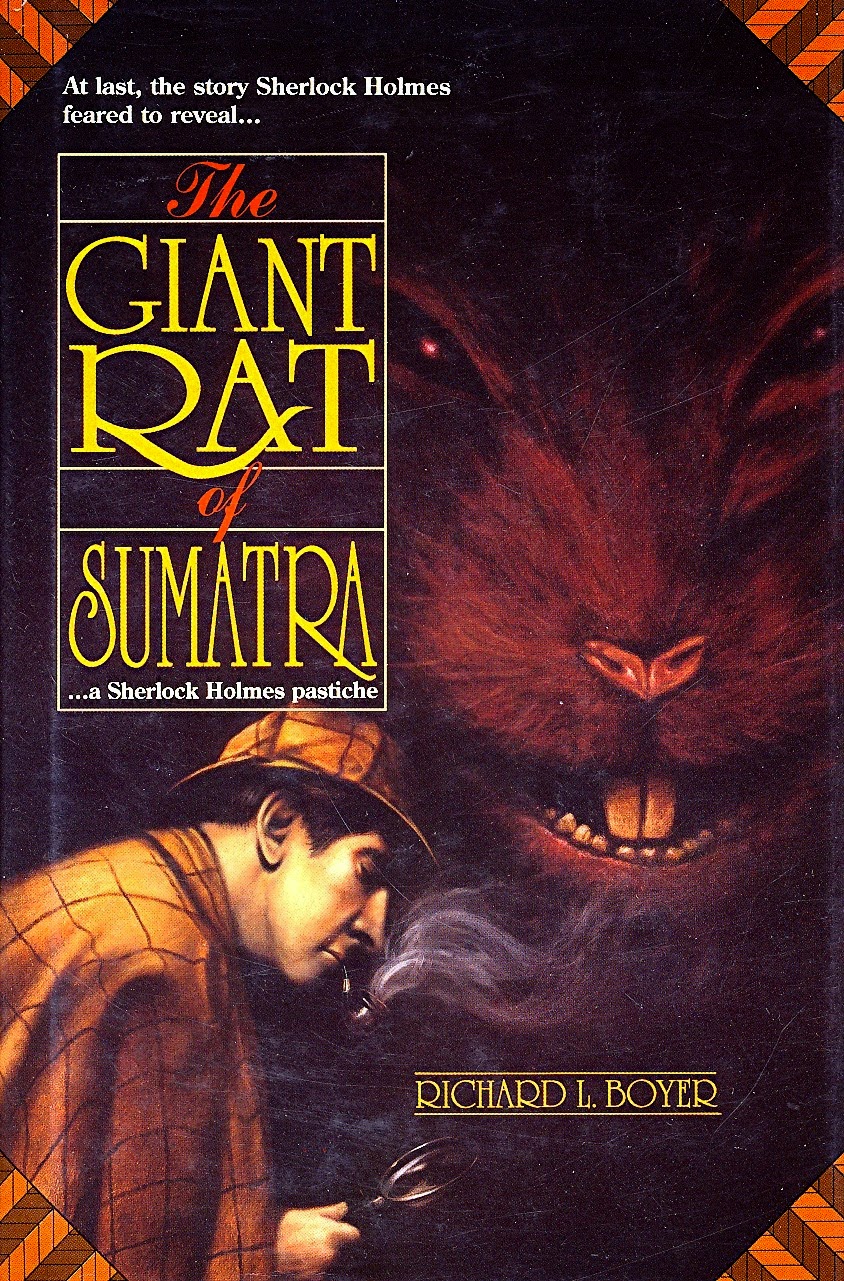
#3 - The Giant Rat of Sumatra by Richard L. Boyer - "The story for which the world is not yet prepared" is without doubt the most famous of all the untold Sherlock Holmes adventures referenced in the canon. Dozens of variations on the concept have seen print, but the version penned by Richard Boyer is a work of sheer genius. Few writers have captured the original Doylean style of writing the way Boyer did, and presents his characters faithfully.

When a seaman drops dead on Holmes' doorstep, Holmes and Watson are drawn into a complex mystery which surrounds a mysterious ship called "The Matilda Briggs." Investigating further, the duo soon discover a link to a recent kidnapping and will face an old foe in doing so. What is so impressive about the plot for The Giant Rat of Sumatra is that it is a genuine mystery, with clues dropped all the way through which only the most keen of readers will see. Oftentimes, a pastiche leans towards being an adventurous novel, which is fine, but it's fantastic to see an author craft a truly intricate mystery for the great detective to solve. That's not to say that there is no adventurous spirit in the novel - the climax in particular is quite dramatically realised with its fantastic twist ending. I do not want to divulge too much as much of the fun of The Giant Rat of Sumatra is being lead on the same path to discovery as the detectives.

#2 - The House of Silk by Anthony Horowitz - I think part of the appeal of The House of Silk is that it was penned by an author of a high calibre. What's more, Anthony Horowitz shows that he is a genuine fan of Arthur Conan Doyle and the original stories in his pastiche, surely the best Holmes pastiche of recent memory. Advertised as Holmes' darkest case, the claim is certainly true. While investigating a man's claim that he is being pursued by a dangerous criminal, Holmes and Watson become entangled in a web of devilry and deceit. They are faced with one seemingly unanswerable question throughout their investigation: what is the House of Silk? Little do they know what dangers the pursuit of that answer shall bring.

Horowitz's fidelity to the canon is excellent with fine portrayals of the principle characters. His tone does differ at times from Doyle's, but Horowitz fill his pages with references to the originals which are sure to warm the heart of any Sherlockian. The plot is tense and incredibly suspenseful, putting Holmes and Watson in a number of truly compromising situations. And Horowitz's prior experience writing for Agatha Christie's Poirot and Foyle's War comes into play as he manages to pull off when the greatest twist endings in any pastiche I have ever comes across.

And (drum roll please)...

#1 - The Veiled Detective by David Stuart Davies - Writing a pastiche is a difficult enough task. Writing a pastiche which tries to do something very different with its central characters is another matter entirely. But David Stuart Davies managed to pull it off wonderfully in what I believe to be the greatest Sherlock Holmes pastiche I have ever read. The Veiled Detective makes for absolutely compulsory reading once you've started.

The premise finds a medical doctor named John Walker hired by Professor Moriarty to spy on a detective named Sherlock Holmes. Assuming the name Watson, Walker moves into Baker Street and together the two begin work together as detectives, embarking on some of their most famous cases, the real details of which are finally made public. The Veiled Detective portrays its central figures in a different light - all are flawed, very real human beings. The original plot aside, the novel is a brilliant character study and allows the reader to examine the close friendship between Holmes and Watson in a way which has not been possible before. I was blown away by this book when I read it for the first time some four years ago and it has left a tremendous impact on me to this day. If you're interested in a fascinating character study of the world's greatest detective, The Veiled Detective is highly recommended.

As always, I open it up to you now. What do you think of the list? Did I leave one of your favourites off? Feel free to leave a comment below.

Thursday, December 4, 2014

The Top 10 Sherlock Holmes Pastiches (Of All Time) Part I

It is nearly impossible to list every single Sherlock Holmes pastiche which has ever been published in some form. There are a myriad of them in film, television, audio and print form. Having already examined movies and television, I'm excluding those from this list and focusing mostly on Sherlock Holmes novels or short story collections.

#10 - The Seven-Per-Cent Solution by Nicholas Meyer - Without doubt one of the most widely-known pastiches, Nicholas Meyer's novel brought the detective back into the limelight, and though not the first pastiche, turned the Sherlock Holmes pastiche into a literary sub-genre. Meyer boldly decided to present an alternate version of the original canon in his novel, deciding to inform readers what really happened during Sherlock Holmes' presumed death.

In the thralls of cocaine addiction, Holmes begins to persecute his old maths tutor, Professor Moriarty. Knowing that Holmes is doing harm to both the Professor and himself, Watson manages to lure the detective to Vienna to see Sigmund Freud. Freud will work to cure Holmes of his addiction, but no sooner has the treatment begun than Freud, Holmes and Watson are thrown into a case. Meyer's novel is fast-paced and engaging as he managed to capture Doyle's original tone excellently. The story, while aggravating to the most devout Doylean, is an interesting alternative history, and the novel is written with such conviction that the story line is not too far fetched. As I noted above, The Seven-Per-Cent Solution was not the first Sherlock Holmes pastiche, but it made writing them popular and the novel became a bestseller, ultimately spawning two (lesser) sequels and a beloved film adaptation.

#9 - The Exploits of Sherlock Holmes by Adrian Conan Doyle & John Dickson Carr - This collection of short stories has the distinction of being authored by Conan Doyle's own son and master mystery writer John Dickson Carr. Together, the two collaborated on a series of short stories, each one based on references made to untold stories from the canon. What resulted is a milestone in Sherlockian history, and some of the finest crafted short stories in the detective's long literary history.

Though there are some stories which are easily forgettable in the collection, some make worthwhile reading on their own. "The Adventure of the Black Baronet" concerns an impossible mystery and a family curse which Holmes must solve in order to acquit a wrongly-accused woman. In "The Adventure of the Seven Clocks," Holmes must determine why a mild-mannered man becomes enraged at the mere sight of a clock, and discovers political implications in the case. And in "The Adventure of the Deptford Horror," Holmes and Watson face another locked-room puzzle, and a means of committing murder which made my hair stand on end when I first read this collection. Written in an extraordinarily authentic voice, The Exploits of Sherlock Holmes are some of the finest Sherlock Holmes short stories which I have ever happened across.

#8 - The Ordeals of Sherlock Holmes by Jonathon Barnes - Though the only pastiche that is not a published book on this list, this Big Finish audio drama simply had to be included. Writer Jonathon Barnes has created four, interconnected cases from four periods in the great detective's career. Holmes and Watson will face danger at every turn as they take on what amounts to be one of their most epic adventures.

The Ordeals of Sherlock Holmes is truly a story of epic proportions. Each of the four hour-long audio recordings are set in a different decade, beginning with Holmes just starting his career as a consulting detective and ending with the detective having long-since retired. The mysteries are truly engaging and thrilling, complimented by Nicholas Brigg's excellent turn as Holmes, and Richard Earl's remarkable reading as Dr. Watson. Big Finish has crafted some excellent Sherlockian offerings, but The Ordeals of Sherlock Holmes is certainly among their best. (As an aside, Big Finish's next Jonathon Barnes-scripted Sherlock Holmes series, The Judgement of Sherlock Holmes is to be released later this December.)

#7 - Dr. Jekyll and Mr. Holmes by Loren D. Estleman - In the pastiche world, it's fairly common for two literary characters to meet. One of the best examples of this is Loren D. Estleman's Dr. Jekyll and Mr. Holmes which brilliantly weaves Holmes and Watson into the plot of Robert Louis Stevenson's original novella. Though the twist ending of Stevenson's story is known the world over, it's fascinating to see the original portrayed as a mystery once more, and part of the suspense and enjoyment of the story is seeing Holmes piece together the clues to come to the inevitable conclusion.

Estleman presents a very authentic Sherlockian voice, which adds further to the pastiche. Holmes and Watson are presented remarkably well as are Stevenson's characters, and their interaction is seamless. Taking no liberties with the original Dr. Jekyll and Mr. Hyde, Estleman has managed to create one, unique plot which doesn't feel disjointed in any way. It is interesting to note that Dr. Jekyll and Mr. Holmes was Estleman's second Sherlockian foray - his first being the rather melodramatically titled Sherlock Holmes vs. Dracula. Much like the novel which followed it, Sherlock Holmes vs. Dracula incorporated Sherlock Holmes in the plot of Bram Stoker's novel, but not in the same flawless manner as this pastiche.

#6 - The Scroll of the Dead by David Stuart Davies - This particular pastiche will also hold a special place in Sherlockian heart as it was the first pastiche I ever read. David Stuart Davies, one of my favourite Sherlockian writers, has written what is perhaps the most exciting, action-filled novel of its kind. Matching wits with a maniac, Holmes and Watson must use all of their resources as they hunt down an ancient Egyptian papyrus which claims that it can raise the dead from their graves. As they embark on their dangerous mission, the duo do not who they can and cannot trust.

The Scroll of the Dead is an un-apologetically exciting novel. It is filled throughout with set-pieces which make for exciting reading, linked together by a complex plot, wrought with twists, turns and suspense. Throughout, Davies writes with an unmatched replication of Doyle's original making The Scroll of the Dead (for all of its outlandishness) feel like an original Sherlock Holmes novel. It's an overall fun, exciting read which should thrill and delight any Sherlockian.

So, we've come to the end of part one. Come back next week as I look at the top five best Sherlockian pastiches. As we enter the holiday season, maybe you'll find the ideal gift for that Sherlockian on your list...

Saturday, November 29, 2014

Review - "The Devil's Promise"

The Devil's Promise is perhaps best described as an unconventional Sherlock Holmes pastiche. I might as well say now that I enjoy unconventional pastiches. If handled correctly, these novels can provide some extraordinarily entertaining reading. Written by David Stuart Davies, one of my favourite Sherlockian writers, The Devil's Promise features Holmes and Watson entangled in a most unorthodox problem. How did it fare overall? Let's find out.

On holiday in the English seaside, Sherlock Holmes and Dr. Watson are soon embroiled in a mystery. The duo discover a body on a secluded beach, which promptly disappears. Deciding to investigate, Holmes and Watson soon find that the residents of the sleepy seaside hamlet are behaving oddly, seemingly intimidated by the Blackwood family who live in a secluded mansion outside of town. According to local lore, the Blackwood's father was a renowned Satanist who tried to conjure the Devil during a black mass. Sensing a potential lead, Holmes and Watson are prepared to investigate further when they are attacked in their rented cottage. In the struggle Watson is knocked out cold.

When the good doctor comes to, he discovers that months have passed. Returning to Baker Street with Holmes, Watson finds that his friend's personality has changed dramatically - the detective is far more distant and cold. What could have caused this change in character, and what happened after the two men were attacked months earlier? Watson will set out on his own to discover the truth, putting not only his life in jeopardy, but Sherlock Holmes' as well.

The Devil's Promise summed up in the above two paragraphs clearly shows that it is a different breed of Sherlock Holmes pastiche. However, I was drawn into the mystery almost from the beginning and I found myself finishing the novel in only a few sittings. While it may not please the most conservative of Sherlockians, the novel was obviously written by an ardent Holmes fan who managed to craft an ingenious plot around Holmes and Watson. There were many twists and turns in the plot which made for edge-of-your-seat reading, and the idea that Watson is alone in his investigation, unable to trust Holmes added much tension to the story.

The twisting plot was complimented by wonderful atmosphere. The book was filled with a sense of foreboding, impending doom which practically jumped off of the page. Just as Davies' Sherlock Holmes-vs.-Dracula novel The Tangled Skein was an obvious homage to Hammer horror films, The Devil's Promise fit the same mold. There were several Gothic nuances throughout the story and the climax was the typical blood-and-thunder set piece seen in a Hammer horror. The book particularly mirrored Hammer's 1968 film The Devil Rides Out which starred Christopher Lee fighting the forces of the Devil and a group of insane Satanists.

While the book was quite good, it's plot did make a few things difficult. There were few scenes which Holmes and Watson shared together and seldom were the detective's deductive prowess put on show. But, these were all compromises which had to be made considering the novel's plot. Therefore, I happily say that David Stuart Davies has delivered once more. The Devil's Promise is filled with twists and unexpected turns and tremendous Gothic atmosphere. I give the book 4 out of 5 stars.

Sunday, November 23, 2014

A State of the Blog Address


I just wanted to take a moment and apologize for my recent in-activity on this blog. I have been very busy lately and as much as I would like to keep the blog up-to-date, I simply haven't had the time.

I cannot say with certainty how much time I'll be able to devote to posts over the next few months, but I will try my best to post a few reviews and thoughts whenever I have the chance. There's a few things on the horizon which I hope to devote some time to.

So, in all, don't lose faith dear readers - though my output may not be as tremendous in the past, I have not forgotten my blog. I hope you check back periodically as I do have a trick or two up my sleeve.

Monday, November 10, 2014

Review - "Doctor Who: Dark Water/Death in Heaven"


Warning - This review will contain spoilers!

Well, another season of Doctor Who has come to an end. How did the finale, a two-part story scripted by showrunner Steven Moffat fair and how it stand up against the rest of the series? How did Series 8 fare compared to the other seasons of the show and what of Peter Capaldi? I hope to answer all of these questions in the following review, so without further let's dive right in...

Distraught over the death Danny Pink (Samuel Anderson), Clara (Jenna Coleman) almost incapacitates the Doctor and his TARDIS by throwing the time machine's seven keys into a volcano. Seeing how far she would go to save the man she loved, the Doctor (Peter Capaldi) takes Clara to 3w, a mysterious institute fascinated with death. The Doctor comes face to face with Missy (Michelle Gomez), the strange woman who has dogged his heels throughout the series, and together they manage to contact Danny in heaven. No sooner have they accomplished this does the Doctor learn that 3w is harboring Cybermen and Missy is in actuality his arch enemy, the Master! With the future of planet Earth hanging in the balance, the Doctor will have to use UNIT to save the day. But at what cost?

When it comes to two-part episodes like this, I tend to find one portion to be better than the other. Here, Dark water/Death in Heaven managed to remain consistent throughout. I must applaud Steven Moffat for keeping the tone the same throughout the two episodes, even when plot twists are introduced and the scale becomes much grander in the second half. I do not hesitate to say that these two episodes have been two of the darkest episodes in Doctor Who's recent history, dwelling on subjects like death and the afterlife, rather taboo for a children's show. However, I found it to be quite compelling and original. I would be lying if I said I wasn't drawn in - especially by the episode Dark Water which had to lay on the mystery extra thick.

The Doctor and the Master - or is Mistress?
We'll revisit the story itself in a minute, but I need to take the opportunity to address the performances from the principles. Peter Capaldi pulled out all the stops in these two episodes. He is without doubt the best actor to have taken on the role of the Doctor since the revival in 2005 and, aside from Matt Smith, is my favorite Doctor. The changes which we the audience have witnessed in his character since the start of the series have been tremendous - a truly brilliant character arc. I look forward to Capaldi's future in the role as I know he will retain that tremendous quality.

Also of particular note was Michelle Gomez as Missy. When it was revealed she was in fact the Master at the end of Dark Water, I wasn't quite sure what to think. (Not to sound too narrow-minded, but I have never been a big proponent of the whole gender swapping thing.) I reserved my judgment and I must say she did an excellent job. Gomez communicated a sense of the Master's true deranged character in a cold, quiet manner which was far more successful than John Simm's scenary-chewing attempts when he played the character. It wouldn't be too outrageous to liken Gomez's Master (Mistress, whatever) to Anthony Hopkins' Hannibal Lector; speaking quietly and delivering a genuine chill up the spine.

While the scripts for Dark Water/Death in Heaven fared well for Capaldi and Gomez, it fell rather short when dealing with the companions. Jenna Coleman delivered her usual fine performance but it seemed like the independent nature of Clara's character became a bit too outrageous when she virtually kidnaps the Doctor and nearly destroys the TARDIS. What's more, this scene, which really goes nowhere, was hardy linked to the rest of the episode. Samuel Anderson, who usually gave a pretty decent performance in the past, seemed rather flat here, especially once he's been turned into a Cyberman. I don't want to bash too much on the script - especially since it did afford Capaldi one of his greatest Doctor moments; skydiving from a crashing airplane without a parachute, tearing a page from James Bond's playbook in Moonraker.

As I said at the top of this review, both episodes of the finale fared equally. Therefore, I give them both 3.5 out of 5 stars. So, in all, how did Doctor Who series 8 fare? Rather well. It featured some truly excellent episodes, but a fair share of mediocre ones. I'd say the series did afford Peter Capaldi a nice introduction and I look forward to his future in the role.